

Introduction: The Transformation of Google Ads
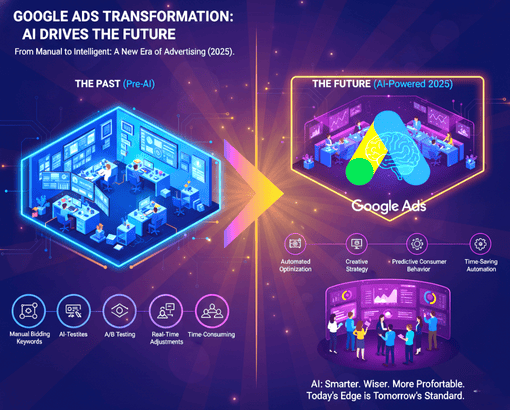
Google Ads has transformed and evolved a lot over the years. There are no more manual adjustments or endless addition of keywords. Artificial Intelligence is driving advertising in 2026. Besides predicting consumer behaviour, it also optimizes campaigns. This is the future that Google is providing, and the advertisers embracing it first are faring the best.
Today, 2026, Artificial Intelligence (AI) is the foundation of advertising on Google. Instead of marketers spending their valuable time on bidding, targeting, and A/B testing, Google’s AI now foresees how customers are going to behave, optimizes advertising campaigns in real-time, and makes advertising smarter, wiser, and more profitable. This isn’t the future it’s now. And the advertisers that lead early are the ones winning the competitive edge.
In this article, we’ll explore the latest AI-driven Google Ads trends, why they are essential, and how both small and large businesses can adopt them successfully.
Important Trends Influencing AI in Google Ads
1. Performance Max Campaigns: The All-in-One Solution
Performance Max is Google’s premiere AI-driven campaign format that combines multiple channels: Search, Display, YouTube, Discover, Maps, and even Gmail into one unified campaign.
Rather than having marketers manage each ad type in isolation, Google’s AI determines when, where, and how to display ads to drive the most conversions.
Example: A local fashion brand using a Performance Max campaign doesn’t only show up in search results when users search for “summer dresses.” Their ads also appear on fashion advice videos on YouTube, in Gmail promotions, and on Google Maps when users search for stores nearby all automatically optimized for performance.
Keyword opportunity: Performance Max campaigns 2026, Google AI advertising, best AI campaigns for businesses
2. AI-Driven Bidding: Intelligent Decisions in the Moment
Google’s machine learning has taken bidding beyond guesswork. It bids for the right audience at the right time, considering hundreds of variables in a split second device, time of day, location, search intent, and history to make winning bids within budget.
Example: A fitness equipment store might experience more conversions during mobile searches in the evening. AI automatically raises bids then and lowers them during low-conversion periods, without human intervention.
Keyword opportunity: AI bidding strategies Google Ads, intelligent bidding versus manual bidding, AI bidding process 2026
3. Predictive Targeting
This is perhaps the most exciting development. Google studies users’ behavioural patterns and shows ads even before they start typing a search, capturing intent earlier.
It considers browsing habits, purchase history, and other signals to display ads before a user has fully defined intent.
Example: If someone is reading travel blogs and watching videos about “Best places to visit in Japan,” Google may begin showing ads for flights and hotels in Tokyo even before the user searches “cheap Japan flights.”
Keyword opportunity: predictive targeting Google Ads, AI consumer behaviour prediction, intent-based marketing
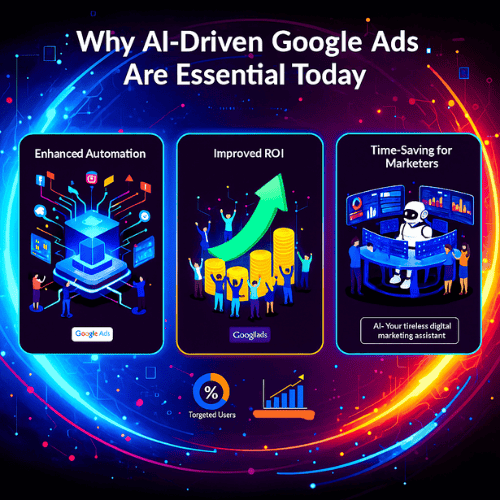
Why AI-Driven Google Ads Are Essential Today
Enhanced Automation
AI (artificial intelligence) trains itself by processing massive amounts of data to instantly optimize ads. With Facebook, Google, and Instagram competing, multichannel, cross-referenced ads are the new standard.
Improved ROI
By targeting users with the highest probability of converting, businesses cut costs and maximize returns. AI ensures marketing budgets are allocated effectively.
Time-Saving for Marketers
Less manual work means more time for creative strategy. Imagine AI as your tireless digital marketing assistant one that never rests, never tires, and keeps learning continuously.
How Companies of All Sizes Can Leverage AI in Google Ads
1. Start with Performance Max
Even small businesses with limited budgets can start with Performance Max campaigns. AI handles multi-platform reach without added workload.
Example: A small bakery can use Performance Max to appear in local “near me” searches, on Google Maps, and in YouTube recipe videos without managing separate campaigns.
2. Utilize First-Party Data
Upload customer lists, CRM data, or website visitor data to let AI target more accurately. With privacy shifts and the fall of third-party cookies, first-party data is now gold.
Example: A gym uploading member email lists can run personalized ads for membership renewals or offers.
3. Test Responsive Search Ads (RSAs)
RSAs let you enter multiple headlines and descriptions. Google’s AI automatically tests different combinations to find the top performers.
Pro tip: Always review results. AI finds what’s effective, but human insight is still needed to refine messaging.
4. Keep the Human Touch
AI can optimize, but storytelling and creativity remain irreplaceable. Data-driven precision comes from AI, but human imagination makes ads memorable.
Examples of AI in Daily Life
- E-commerce: Brands like Puma and Nike use AI-driven Google Ads to retarget based on purchase history, showing personalized product ads on YouTube, Search, and Shopping.
- Local Businesses: Restaurants use AI to show ads during “food near me” searches at mealtimes.
- B2B Businesses: SaaS platforms apply predictive targeting to reach decision-makers using LinkedIn activity, search intent, and browsing history.
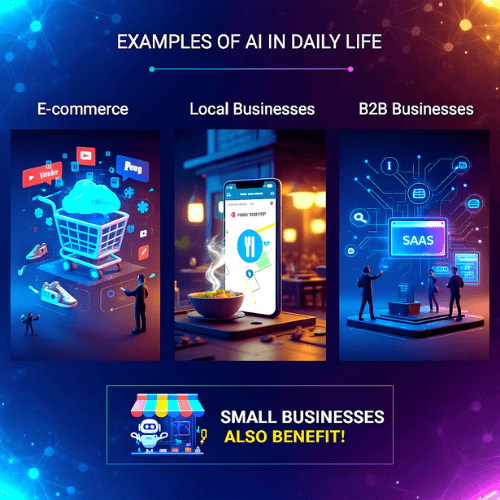
AI is not limited to big corporations. With the right strategy, small businesses can also reap its benefits.
Conclusion: AI is the Future of Google Ads
AI in Google Ads is not just a trend it’s the future of advertising. Businesses that embrace automation, smart bidding, and predictive targeting will leave their competitors behind.
In 2026, the rule is simple: AI doesn’t replace marketers; it empowers them to be 10x smarter.